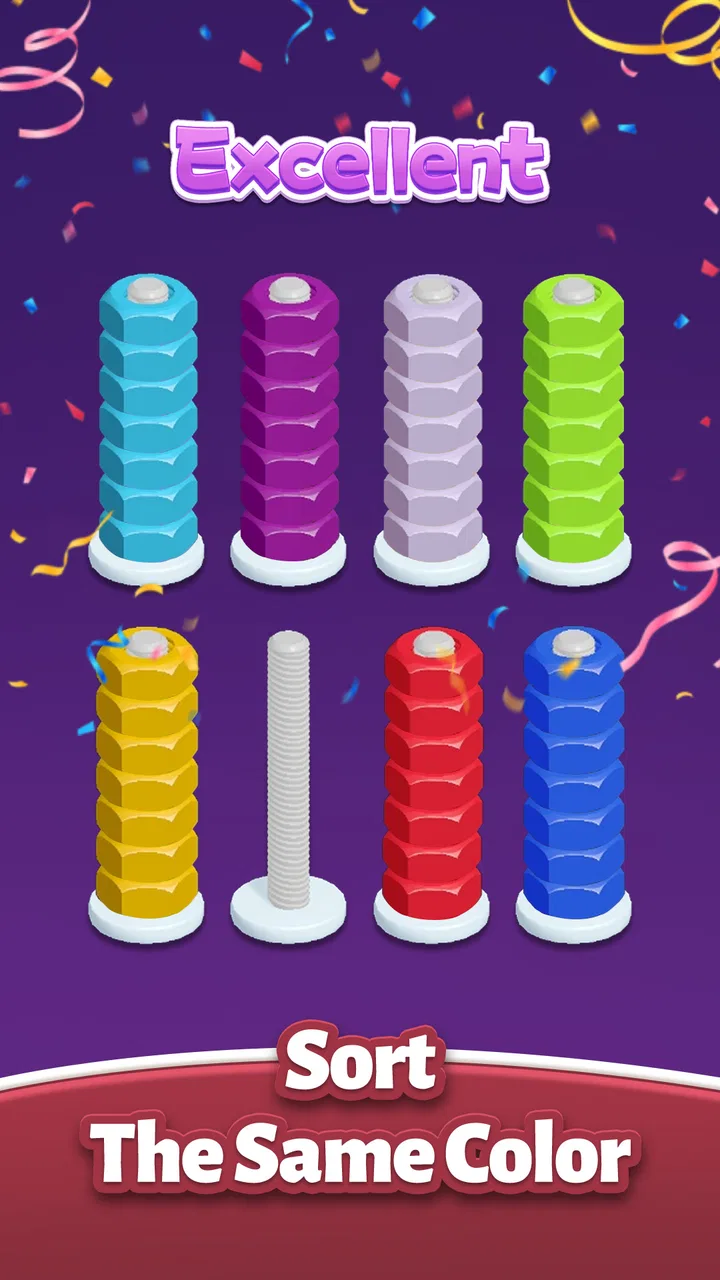
Nut Sort:Color Puzzle Game
- 4.7
- Rating
- 500.00K
- Installs
- Free
- Price

 Analysis by App-foxy
I spent time with Nut Sort: Color Puzzle Game, a casual title built around one clear idea: sorting colored nuts into matching containers. That sounds simple, and the first moves are simple, but the game quickly turns that basic action into a small planning exercise. I found myself thinking less about speed and more about which move would keep the board flexible several turns later.
That focus is the game’s strongest quality. It does not need a complicated story, a large cast of characters, or a long tutorial to give me something to solve. The appeal comes from reading the arrangement in front of me, spotting blocked colors, and deciding whether a seemingly helpful move will actually leave me with enough room to finish. If you enjoy quiet puzzle sessions that can fit into a short break, this is an easy game to understand and surprisingly easy to keep playing.
Why the sorting mechanic works
The central capability is color sorting, but the useful part is not simply matching one color with another. The real challenge is managing space and order. A color may be visible but unavailable because another nut has to move first. Clearing that obstruction can open a solution, yet it can also fill a container that you later need for a different color. Every move therefore has a consequence, even when the board initially looks nearly solved.
You May Also Like

 AccuWeather: Weather Radar
AccuWeather Review: A Quick, Clear Forecast for Everyday Decisions
For everyday plans, the best forecast is the one you can understand quickly. AccuWeather makes rain timing, radar, and local conditions easy to act on, with a few trade-offs.

 Hill Climb Racing
Why Hill Climb Racing Still Turns Crashes Into One More Run
A tiny car, a bumpy hill and one more upgrade: Hill Climb Racing keeps resurfacing because its simple chaos makes every near-miss feel personal.

 AliExpress - Shopping App
AliExpress Makes Global Shopping Feel Personal, but Shoppers Bear the Risk
AliExpress turns a global marketplace into a pocket-sized discovery engine. Its reach is useful, its shopping loop compelling, and its trade-offs easy to miss.

 Lords Mobile: Kingdom Wars
Lords Mobile Is a Kingdom-Building Routine, Not a Quick Match
A case-by-case verdict on the building, battles, device demands, and social commitments that make Lords Mobile rewarding for some players and exhausting for others.

 PDF Scanner app - TapScanner
TapScanner Makes Paperwork Easier to Capture, Check, and Share
TapScanner makes scanning with a phone feel less like a rescue operation and more like a dependable step in getting work done. Its capture tools are useful, though not flawless.

 Block Blast!
 Shows How Much a Puzzle Game Can Leave Out
A quiet grid game shows why puzzle players increasingly value instant clarity, repeatable skill and low-pressure play—and where the genre still needs to catch up.
More From Our News Desk
View All News


I liked that this creates a gentle form of forward planning without making the game feel like a formal strategy title. I can look at the current arrangement, identify the most restricted color, and work backward from it. A color with only one possible destination deserves attention before a color that has several possible homes. That small change in thinking makes the puzzles feel more deliberate than ordinary tap-and-match games.
The game belongs firmly to the casual category, and that is important to set expectations. It is approachable enough for someone who does not normally play puzzle games, but it still rewards patience. You do not need to learn a complicated control scheme. The mental work comes from arranging the board, not from mastering timing, combat, or a long list of menus.
In my experience, the most satisfying moments came when I avoided an obvious match. Moving the visible color immediately can feel correct, but preserving an open space may be more valuable. That is the kind of small trade-off that gives the title its character. The board becomes a conversation between what I can do now and what I want to make possible later.
What a good move looks like
A good move is not always the one that reduces the number of unsorted nuts. Sometimes the better choice is to create room, expose a hidden color, or keep a destination available. I started checking three things before tapping: which container is nearly full, which color has the fewest destinations, and whether the move will leave an empty place for an unexpected problem.
This approach is especially useful when several colors appear ready to be matched. I found that solving the easiest group first can remove useful flexibility. It feels efficient, but it may force a later color into an awkward position. By contrast, handling the most constrained group first often makes the rest of the board easier to read.
That is a concrete insight the short store summary cannot really communicate. The game is not only about recognizing colors. It is about protecting options. If you treat every open space as valuable rather than empty, you will make fewer frustrating mistakes and understand why some boards feel much tighter than others.
How it feels during an ordinary session
The controls are easy to pick up because the interaction follows the puzzle’s visual logic. I choose a nut or group and direct it toward a matching place, then watch the arrangement change. The simplicity is helpful when I want to play without committing to a large experience, although it also means the game depends heavily on the quality of its level design and the clarity of each board.
I would not describe the experience as something I play for action or surprise. Its rhythm is closer to arranging objects on a desk until the mess makes sense. That makes it a good fit for a quiet moment, but a weaker choice if you want constant novelty or a strong narrative reason to continue.
One realistic use case is a short waiting period when I want something more engaging than scrolling but less demanding than a competitive game. I can open it, solve part of a puzzle, and put the phone down without needing to remember a complicated plot or coordinate with other players. When I return, the core task remains immediately understandable.
The same quality can become a limitation. If you prefer games with varied environments, character progression, or a sense of discovery beyond the board, this focused format may feel repetitive. The title knows what it wants to be, and it does not try to disguise a sorting puzzle as something much larger.
A practical method for difficult boards
When I reached a board that seemed stuck, I stopped looking for the next match and instead looked for the next release. A release is a move that frees a container or reveals a color that was previously trapped. This shift is useful because the visible match is often not the true problem. The true problem is lack of access.
I also learned to avoid filling a spare container too early. An empty space feels like an invitation to make progress, but once it holds the wrong color, it may stop being useful. I try to keep at least one flexible destination available while I work through the more restricted colors. This is not a formal rule that guarantees success, but it is a dependable way to reduce dead ends.
Another helpful habit is to pause after each major rearrangement. The board can look worse for a moment because several colors have moved away from their eventual homes. That does not necessarily mean the move was bad. I found that allowing the new layout to settle visually made hidden routes easier to notice than tapping quickly through familiar matches.
These habits make the game more rewarding for thoughtful players, but they also reveal its main demand: attention. A distracted session can turn a manageable puzzle into a frustrating one. If you want something that plays itself while you watch television, this is probably not the right kind of casual game. It asks for a little concentration, even when the controls are uncomplicated.
The best setting for Nut Sort
The strongest scenario for me was a brief, low-pressure break. Imagine waiting for an appointment or taking a pause between tasks. The game gives that time a clear shape: inspect the board, make a few decisions, and stop when the puzzle is complete or when your attention needs to return elsewhere. It feels more purposeful than an endless feed while remaining lighter than a long-form strategy game.
It can also work for players who enjoy visual organization. If you like arranging shelves, grouping objects, or solving small logic problems, the matching structure should feel natural. The color-based presentation makes the goal readable quickly, which helps new players begin without studying instructions for long.
Parents may also appreciate the Everyone content rating as a sign that the game is aimed at a broad audience. I would still treat it as a puzzle for shared expectations rather than assuming every child will find it equally easy. Color recognition and planning are central to the experience, so enjoyment depends on the player’s comfort with those tasks.
For someone who wants a game to play with friends in real time, however, this is less suitable. Its appeal is personal concentration rather than social competition. I would choose a multiplayer title for group entertainment and keep this one for moments when I want to solve something at my own pace.
Where the trade-offs become clear
The focused design is both the reason to try the game and the reason some people will lose interest. There is a clean pleasure in improving at one mechanic, but players who need frequent changes may find the experience narrow. I never felt confused about the goal, yet I sometimes wanted a stronger sense of variety around that goal.
There is also a difference between challenge and inconvenience. A difficult arrangement can be satisfying when I can identify the mistake in my reasoning. It is less satisfying when I feel that I am repeating guesses without gaining new information. My best sessions were the ones where the board taught me something about sequencing. If a level only feels like trial and error, the calm puzzle mood weakens.
That is why I recommend playing slowly rather than treating the game like a speed challenge. Rushing makes the sorting mechanic feel more restrictive than it really is. Taking a moment to map the available destinations often turns a seemingly blocked position into a manageable one. The trade-off is simple: the game rewards thought, not frantic tapping.
Another practical consideration is device compatibility. The game supports Android devices running version 7.1 or later, so it is not limited to only the newest phones. That makes it a reasonable option for people using older compatible hardware, provided the device meets that requirement.
What the audience response suggests
The game has reached more than one hundred thousand installs and holds a 4.7 average from around twenty thousand ratings. I do not treat those figures as proof that every player will enjoy it, but they do suggest that the straightforward sorting loop has found a receptive audience. The title also has hundreds of written reviews, which fits the sense that players have enough to say about the puzzle experience beyond simply opening it once.
It is free to play, which lowers the barrier to trying it during a spare moment. I still recommend judging it by the feel of the core mechanic rather than by the absence of an upfront cost. A free game is only worthwhile if its central activity suits you, and here that activity remains color grouping, space management, and sequencing.
SATORISYS PLAY keeps the identity of the game centered on that puzzle loop. The current release is version 1.5.6, and the game was released on March 27, 2025. Those details matter mainly because they help identify the edition a reader is considering, while the day-to-day decision is simpler: do you enjoy sorting problems that become harder through limited space and order?
Who will get the most from it
I would recommend this game to people who like compact logic challenges, visual organization, and self-paced play. It is especially suitable if you want a title that can be understood quickly but still gives you a reason to reconsider your first move. The best players will not necessarily be the fastest. They will be the ones who preserve options and notice which color is creating the bottleneck.
It is also a good choice for casual players who normally avoid complicated games. You can approach it without learning a large system, and the familiar act of matching colors makes the purpose clear. At the same time, experienced puzzle fans may enjoy testing their ability to plan several moves ahead rather than relying on immediate matches.
I would suggest skipping it if your ideal mobile game needs a story, character development, competitive ranking, or constant mechanical change. I would also look elsewhere if you dislike puzzles where one careless decision can make the remaining arrangement harder to untangle. This is a game for people who can accept a quiet, concentrated pace.
For players who are unsure whether their phone can run it, the minimum Android requirement is version 7.1. The game is rated Everyone, and its free price makes a trial relatively easy. Those practical points answer the first questions most people have before installing, while the more important question is whether the sorting loop itself sounds enjoyable.
My final take after playing
The real strength of Nut Sort is how it turns empty space into a decision. Once I started treating open containers as resources, the game became more interesting than its simple presentation suggested. Each board asked me to balance immediate progress against future access, and that made even familiar colors feel strategically different depending on their position.
I would not call it a universal recommendation. Its narrow focus will not satisfy someone looking for a broad adventure or a social game, and its calm pace may feel repetitive after long sessions. But for short breaks, quiet concentration, and approachable color-based logic, it does its job well. I especially recommend playing with a deliberate rhythm: identify the restricted color, protect a flexible space, and only then commit to the easy match.
In the end, this is a small game with a clear purpose rather than an oversized package of unrelated features. That honesty works in its favor. If you want a free casual puzzle that rewards planning without demanding complicated controls, I think it is worth trying. If you need variety, story, or competition to stay interested, you will probably be happier with a different kind of mobile game.
FAQs for Nut Sort:Color Puzzle Game
01What is the objective of Nut Sort: Color Puzzle Game?
The primary objective of Nut Sort: Color Puzzle Game is to sort colorful nuts into their respective containers, aligning them by color. This puzzle game challenges players to strategize and think several moves ahead to achieve the goal in the fewest steps possible. It's a perfect blend of fun and mental exercise.
02How challenging is Nut Sort: Color Puzzle Game for beginners?
Nut Sort: Color Puzzle Game starts with simple levels that help beginners get acquainted with the mechanics. As players progress, the levels increase in complexity, providing a satisfying challenge. It's designed to be accessible but also offers enough depth to keep puzzle enthusiasts engaged as they advance.
03Does Nut Sort: Color Puzzle Game require an internet connection?
No, Nut Sort: Color Puzzle Game does not require an internet connection to play. This makes it a great option for those who wish to enjoy the game during commutes or in locations where internet access is limited, ensuring uninterrupted gameplay anytime and anywhere.
04Are there any in-app purchases in Nut Sort: Color Puzzle Game?
Yes, Nut Sort: Color Puzzle Game includes in-app purchases. Players can buy hints or remove ads to enhance their gaming experience. However, these purchases are optional, and it's entirely possible to enjoy and complete the game without spending any money.
05What platforms is Nut Sort: Color Puzzle Game available on?
Nut Sort: Color Puzzle Game is available for both Android and iOS devices. It can be downloaded from the Google Play Store for Android users and the Apple App Store for iOS users. Ensure your device meets the minimum system requirements for optimal performance.
Pros
- Engaging and addictive gameplay.
- Simple and intuitive controls.
- Visually pleasing design.
- Challenging levels to enhance skills.
- Suitable for all ages.
Cons
- Ads can interrupt gameplay.
- Limited hints available.
- Repetitive music can be annoying.
- Requires internet for some features.
- Levels can feel similar.

Nut Sort:Color Puzzle Game
Gallery